27.02
Today I decided to create something that could be useful and make life easier for professional traders.
Introducing my product PythCorrelation
Now let’s take a look at the updates we already have.
Market dashboard with key volatility, trend and liquidity metrics for selected assets
Pyth Data integration: live prices, market depth, and real-time feeds from Pyth Network, which form the basis of all calculations.
Pyth Entropy integration: entropy indicators that measure the level of chaos/predictability in the market to immediately see where there is structure and where there is pure noise.
28.02
FAQ and Feedback sections have been added to the app, so the Glo Mo family now has a place where they can quickly find answers to frequently asked questions and immediately leave feedback about bugs, errors, and ideas.
- At the same time, the website is being prepared for publication and the beta test is being launched, with the focus of development currently on two things: a neat interface design and maximum data transfer speed, so that everything works as fast as the markets themselves.
3.03
WTI x GOLD with a strong negative correlation is not just an interesting fact, but a working tool for positioning in macro.
- In practice, this means that when oil prices rise, gold is likely to weaken, and vice versa. This correlation can be used to hedge portfolios, build paired trades between energy and defensive assets, and gauge market sentiment regarding risk and inflation expectations.
7.03
Updating Pyth Chart with pair correlation shifts the terminal from viewing prices to viewing instruments for real-time market connections.
- Now, in the terminal, you can see how the correlation looks directly on the chart, track how accurately each token moves relative to the selected benchmark, and catch moments when the usual synchronisation breaks down — this is where ideas for pair trading, hedging or arbitrage often arise.
8.03
an attempt to assemble a quantum framework for trading on top of Pyth Entropy.
- The idea is that the combination of Entropy + Mutual Information allows us to see not just correlations, but the very structure of the market: we filter out assets with very high entropy as pure noise, look for those where MI is high and entropy is not extreme, and work not with chaotic ticks, but with stable information links between assets — this is the level of structural analysis that usually only quantum funds and HFT strategies reach.
9.03
Now you can compare the correlation of different trading pairs in real time, including BTC/XAU, BTC/WTI and similar pairs, which is especially important against the backdrop of geopolitical events such as the Israel-Iran conflict.
- The plans include adding notifications about changes in correlation, for example, gold is rising, Bitcoin is falling, and backtesting for charts to test ideas on historical data, and then expanding the pool of tokens and adding even more advanced analytics.
11.03
PythCorrelation is already becoming a full-fledged analytical utility, rather than just a tool for viewing correlations.
- Traders can now publish correlation changes or correlation anomalies directly in X, a new welcome page has been added that takes the user to the main site, SPY / QQQ / DIA / IWM indices have appeared, and thanks to the integration of PythPro API, data is transferred much faster — this is critical when you work with market modes in real time.
I would like to emphasise that even minor updates, such as the addition of 14 new coins, are a step towards more dynamic and broader market coverage for us at PythCorrelation.
The larger the pool o
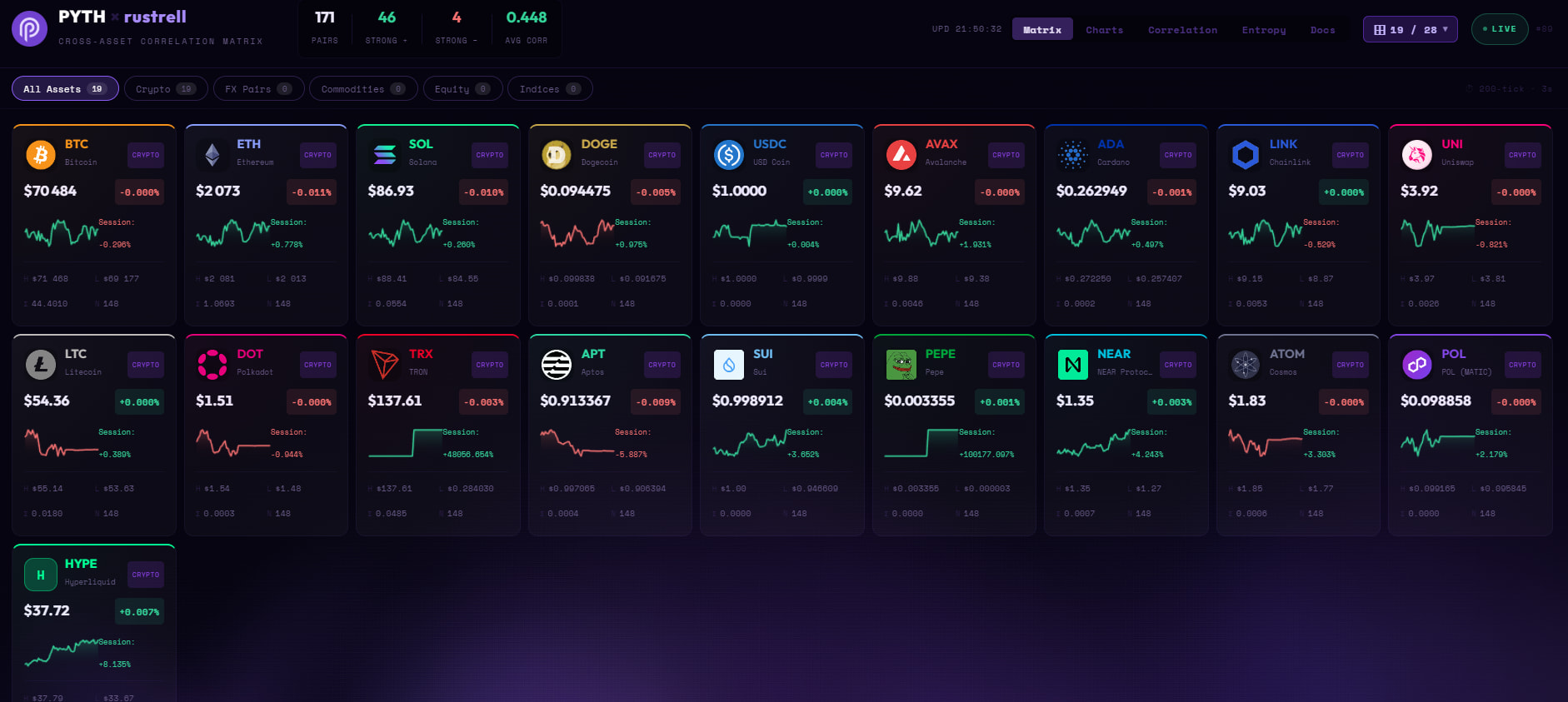
f assets supported by the utility, the more accurately you can build correlation matrices, search for anomalies between niche and mainstream assets, and create more flexible pairing and hedging strategies directly within the ecosystem.